
A few thoughts as we wrap up snow plowing season for 2026.
Why does the quality of snow plowing vary by city? If I had to sum it up in one word that would be: cars. In four words: free public car storage. In eight words: parked cars get in the way of plows.
Let’s start with suburbs. They seem pretty efficient at plowing. What are they doing right? Banning on-street car storage. When you don’t have cars on the streets, plows can plow curb to curb with no obstructions. On the downside, suburbs have more dead ends that they rebrand as culs-de-sac. This makes plowing tedious for drivers by drastically lowering the number of lane miles they can clear at taxpayer expense. Still, most streets are done relatively quickly since no cars are in the way.
Minneapolis largely has a grid street design and uses a three tier plowing system that takes place over ~36 hours. They plow snow emergency routes first to give emergency responders a fighting chance of getting within two blocks of every address (and everyone else a two block shot at access to the outside world) followed by plowing even numbered streets, then odds. The grid allows plows to plow for long stretches without turning. That’s efficient. The biggest hassle is dealing with the car dance between evens and odds. If you live close to a snow emergency route, moving your car onto that street once it’s plowed is a decent option. It’s also not obvious to the majority of Minneapolis residents which side is the odd or even side on the East/West running blocks since they’re largely side streets in most neighborhoods. Some geek goes first and people sheep along. A little stress inducing since no one wants to get towed and is largely trusting whoever started the trend.
St Paul uses a different system with different flaws, but the largest flaw isn’t with the snow emergency system. The first pass is night plow routes, which includes arterials, and downtown (aka snow emergency routes) and one side of North/South streets. After that, they clear everything else, as in the remaining North/South street work plus all East/West streets. If you’re wondering why St Paul plowing tends to suck, the first reason is this: a massive portion of St Paul’s blocks run East/West so that’s where the majority of the publicly subsidized on-street parking happens. When all cars have to get off East/West at the same time there simply isn’t enough capacity on the half-plowed or fully plowed North/South side street to accommodate the demand. So, many people don’t more their cars, leading to plow drivers being unable to plow curb to curb as they weave around cars on both sides of East/West streets.
However, the biggest self-inflicted plowing pain in St Paul is something else. This will be shocking to people living in modern cities, but I swear to you that it’s true: St Paul doesn’t plow alleys. You heard that right. Neighbors have to do it themselves, hire a plow service, or wait until spring. These are alleys used by city contracted garbage and recycling trucks. You’re correct if you’re thinking that this makes no sense. Alleys become nearly impossible to drive down with deep tires ruts of polished ice. Turning out of the ruts into a garage is nearly impossible so people give up.
Why is this a problem? Because car owners aren’t dumb. They understand that they may not be able to get out of their unplowed alley after a storm so they park on the street at the absolute worst time to increase on street parking. This leads to even more vehicles for plows to swerve around, less curb to curb plowing, and more mid-block ice berms taking away parking for weeks.
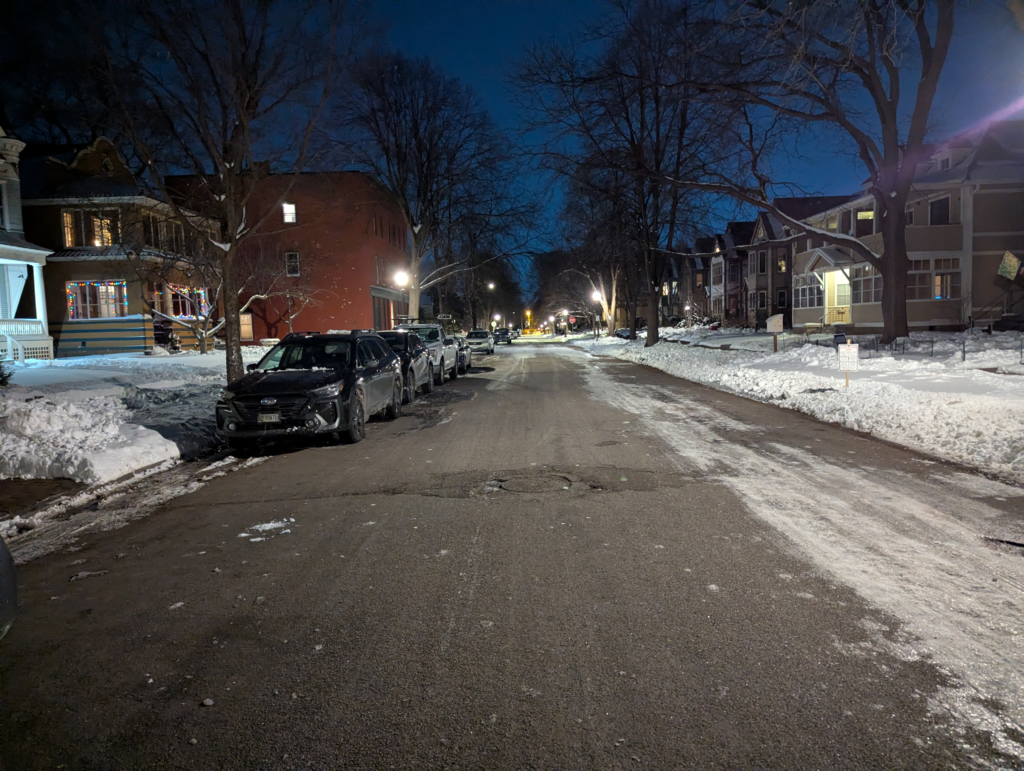
The good news in St Paul is that they’re running a pilot program to test whether something that already works in other cities may work in St Paul too. The picture above is from a street where an even/odd plowing system is being tested. Notice the curb to curb plowing, smooth driving and biking surface, and full compliance from vehicle owners. This is two days after a major spring snowstorm hit the Twin Cities. This is some of the best residential street plowing I’ve seen in St Paul or Minneapolis. There are still far more vehicles parked on this street than their would be if the car owners could access their garages, but the plowing was effective.
So, the next time you’re frustrated with plowing, remember that plowing streets is really an exercise in dealing with vehicles in publicly subsidized parking spaces.

My experience has been that suburbs have more garages and driveways per capita. So fewer cars on the streets to begin with.
Definitely. They’re built around off-street parking.
The alleys in St Paul are plowed better than the streets are. And it’s $20 a winter. The city would do a worse job at 10X the cost.
Do pray tell who is doing the publicly subsidizing on the parking spots? Would that be me and my $12K a year property tax bill? I believe it would!
I’d rather have the ability to park in front my house on marginally plowed streets than some other system. I guess that’s an upside of climate change. It will be less of a problem..
It sounds like you’re severely underpaying whoever is plowing your alley while complaining about property taxes on a home worth nearly a million dollars.
Ten years ago it was $10 a winter! We collect $1000+ from 50 neighbors for 0.25 mile stretch of alley. 20 alleys would probably take a couple of hours. Figure plowable snow 20 times per year. Would be $20K for 40 hours of work? Say it takes twice the time. He’s getting $250 per hour. Sounds about right and fair to me..
I wish my house was worth a million. Try half that. A million dollar home is paying $20K in property tax. I’m not complaining I just don’t want to walk blocks to my house.
And i know it’s cute to say publicly subsidized free parking but seriously who is doing the subsidizing? Me!
I’m not asking for anything special or complaining about taxes. My alley is well plowed and I want to park in front of my house.
Thanks for clarifying the taxes. I was looking only at the St Paul portion earlier.
It sounds like your block has very high compliance for pooling alley funds.
Personally, I think cities would be better off if the converted half the parking space to green space. Quieter, less hot, cleaner,and still plenty of parking.